BOOKS
Published

Read Time

3 min read

Reader rating

4.6

· 165 Amazon ratings
reader ratings, not a LuvemBooks score
Curated & edited by

LuvemBooks Editorial

How we create our reviews →
Share This Review

Sho-Time: The Inside Story of Shohei Ohtani by Jeff Fletcher Review: Essential Beat-Reporter Access, One Elusive Subject

Jeff Fletcher's Sho-Time is the most thoroughly reported portrait of Shohei Ohtani available in English, drawing on Fletcher's years covering the Los Angeles Angels beat to trace Ohtani's journey from a snowy childhood in Iwate Prefecture, Japan, to his historic 2021 AL MVP season — though the subject's own guardedness means the book illuminates the phenomenon more fully than the person behind it.

LuvemBooks Verdict

Best for

Baseball fans who want the most thoroughly reported account of how Ohtani became a major league phenomenon — covering the front-office maneuvering, historical context, and his full arc from Iwate Prefecture through the 2021 AL MVP season.

Worth it if

You want deep organisational and statistical context around Ohtani's rise, drawn from front-office personnel, scouts, coaches, and teammates, and you're content with a portrait of an athlete's performance and career rather than an intimate look at the private person.

Skip if

You're hoping for a revealing psychological portrait of Ohtani himself — his personal guardedness and reluctance to give one-on-one interviews means the inner life of the man remains largely out of reach, however thorough the surrounding reporting.

What readers & critics say

Kirkus Reviews found the book at its liveliest when Fletcher widens the lens beyond statistics, but noted that Ohtani "offers little beyond game-specific comments" and that his interests away from the game remain undiscovered. AllSportsBooks.Reviews judged it "a very enjoyable look at the origins and initial impact of this singular player," while acknowledging the definitive biography awaits the end of Ohtani's career.

He's an ace pitcher, a power-hitting DH, and he's still something of a mystery — a once-in-a-generation talent.

Kirkus Reviews
Sources: Kirkus Reviews, AllSportsBooks.Reviews, muse.jhu.edu
4.6from 165 Amazon ratings— reader ratings, not a LuvemBooks score
In This Review
  • What Works & What Doesn't
  • What the Book Actually Is and Covers
  • The Significance of Ohtani's Story — and This Book's Place in It
  • Strengths: Access, Context, and the Edges of the Story
  • Limitations: The Subject Keeps His Distance
  • Who This Book Is For

What Works & What Doesn't

What Works
  • Fletcher's long-tenured Angels beat access yields deep front-office, coaching, and teammate perspectives unavailable elsewhere
  • Contextualizes Ohtani's achievement within baseball history, including forgotten two-way players from the Negro Leagues
  • Ken Rosenthal of The Athletic called it 'the definitive look at Ohtani's two-way majesty'
  • Covers the full arc from Ohtani's Iwate Prefecture origins through his 2021 AL MVP season with statistical and narrative depth
  • Broadens beyond a single-subject profile to examine why two-way players are structurally rare in professional baseball
What Doesn't
  • Ohtani's personal guardedness — he generally avoids one-on-one interviews — limits the book's portrait of him as a person rather than a performer
  • Kirkus Reviews noted the narrative can become bogged down in statistics, injury details, and low-yield quotes, reducing momentum in places
A beat reporter's deep access makes Sho-Time the definitive chronicle of Ohtani's rise — and the subject's personal guardedness is its one inescapable ceiling.

What the Book Actually Is and Covers

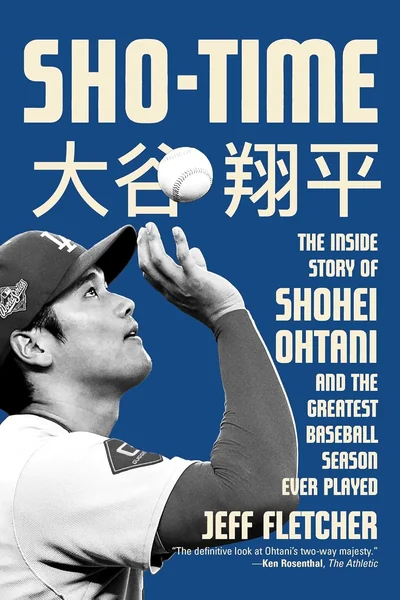
Sho-Time: The Inside Story of Shohei Ohtani and the Greatest Baseball Season Ever Played by Jeff Fletcher front cover
Sho-Time: The Inside Story of Shohei Ohtani is a reported sports biography by Jeff Fletcher, who has covered Major League Baseball since 1997 and logged eight seasons on the Los Angeles Angels beat for the Orange County Register — more time covering Ohtani, the publisher notes, than any other writer in the United States. The book traces Ohtani's origin story in Japan's Iwate Prefecture, follows the international bidding frenzy that erupted in 2017 when he chose to leave Nippon Professional Baseball for MLB, and carries the narrative through his recruitment by the Angels, his injury-marred 2019 and 2020 seasons — including Tommy John surgery and a pandemic-shortened year — and into his landmark 2021 campaign: 157 strikeouts, a 3.18 ERA, 46 home runs, 10 triples, and the American League MVP award. The foreword is written by Angels manager Joe Maddon, signaling the level of organizational access Fletcher secured.
if Ohtani has interests beyond the game, Fletcher hasn't uncovered them.

The Significance of Ohtani's Story — and This Book's Place in It

Ohtani occupies a category of one in contemporary baseball. A rival general manager is quoted in the book calling him part of "a super small class" — "There's one in the world." In a sport that has struggled to cultivate household names in recent years, Ohtani's ability to function as a frontline starting pitcher and a power-hitting designated hitter simultaneously is genuinely without modern parallel in the major leagues. Ken Rosenthal, senior writer at The Athletic, described Sho-Time as "the definitive look at Ohtani's two-way majesty," situating it explicitly as the record-of-reference for the 2021 season. Fletcher also uses Ohtani's story as a lens into the broader history of two-way players, including forgotten figures from the Negro Leagues, and into the structural and economic reasons such players almost never exist in professional baseball.

Strengths: Access, Context, and the Edges of the Story

Fletcher's most valuable material comes from sources orbiting Ohtani rather than from the man himself. He secured insight from Japanese and American front-office personnel, scouts, managers, athletic trainers, and teammates, and reconstructed the mechanics behind Ohtani's signing with a level of detail that pure statistical coverage cannot provide. The physics of Ohtani's game and his technologically advanced training regimen are broken down with the specificity that only a long-tenured beat reporter could assemble. Kirkus Reviews noted that some of the book's liveliest passages arrive when Fletcher widens the lens — catching up with a devoted husband-and-wife pair who follow Ohtani's games obsessively, or excavating the history of two-way players to explain just how rare the combination of talent and circumstance required to produce one actually is. A web source attributed to muse.jhu.edu noted that Fletcher's account reveals Ohtani as a player seemingly more driven by instinct and trust in his own judgment about where to play than by financial calculation — a telling character detail embedded in the reporting.

Limitations: The Subject Keeps His Distance

The book's central tension is structural and unavoidable: Ohtani himself generally declines one-on-one interviews, and that reticence shapes what Sho-Time can ultimately deliver. As Kirkus Reviews observed, Ohtani "offers little beyond game-specific comments," and the book at times becomes dense with statistics, injury minutiae — details about finger blisters, for instance — and quotes that do not reveal much about who Ohtani is away from the diamond. Kirkus concluded plainly that "if Ohtani has interests beyond the game, Fletcher hasn't uncovered them." The result is a portrait of an athlete's career and public performance rendered with authority, but a portrait of the private person that remains, by necessity, incomplete. Readers expecting an intimate psychological study will find the access has limits no reporter could fully overcome.

Who This Book Is For

Sho-Time is best suited to baseball fans who want the fullest available account of how Ohtani came to exist as a major league force — the front-office maneuvering, the physical and historical context, and the season-by-season arc through 2021. It was originally published by Diversion Books in July 2022 and subsequently issued in a reprint paperback edition in August 2023, making the updated edition accessible to readers coming to Ohtani's story after his continued ascent. Fans seeking statistical depth alongside narrative context will find both here. Those less fluent in baseball's analytical vocabulary may occasionally find the density of numbers a barrier, but the broader chapters on baseball history and the curiosities surrounding Ohtani's fanbase give the book reach beyond the hardcore sabermetrics crowd.

Sources & Further Reading

The key facts and claims in this review are grounded in the retrieved, verified sources listed below.

  1. 1
  2. 2

    kirkusreviews.com

  3. 3
  4. 4
  5. 5
  6. 6