6 min read
Share This Review
Ultimate Video Game Trivia Challenge by Lillian Jacobs Review: A Deep-Dive Quiz for Dedicated Gamers
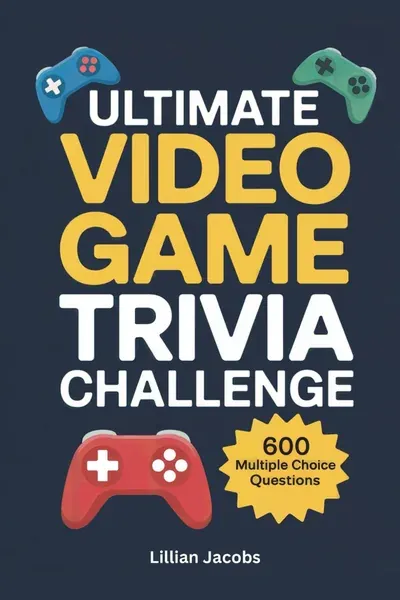
Lillian Jacobs's Ultimate Video Game Trivia Challenge delivers 600 multiple-choice questions spanning classic and modern games, RPGs, music, characters, and gaming history — a purpose-built reference and quiz companion for enthusiasts who want to test the full breadth of their gaming knowledge.
 Tap to enlarge
LuvemBooks Verdict
Best for
Gaming enthusiasts — from retro devotees to RPG specialists — who want a substantial, structured multiple-choice quiz resource for solo self-testing or group competition nights.
Worth it if
You want a high-volume, format-consistent trivia challenge that covers gaming breadth seriously, with dedicated sections for music, characters, RPGs, and history rather than a scatter of surface-level questions.
Skip if
You're looking for narrative context, developer profiles, or cultural essays about gaming — this is strictly a question-and-answer format with no editorial commentary between sections.
Ask LuvemBooks
Was this helpful?
- Is it worth reading?
- For gaming enthusiasts who want a genuine, replayable quiz experience, Ultimate Video Game Trivia Challenge delivers strong value: 600 multiple-choice questions across six well-chosen categories is a substantial pool, not a short-form sampler. The inclusion of dedicated sections on video game music and RPG lore — areas frequently overlooked in general gaming quizzes — signals a commitment to depth that rewards specialists. The key caveat is that it is a pure trivia format; readers seeking long-form exploration of gaming culture or developer history will not find that here.
- Similar books
- Readers who enjoy Ultimate Video Game Trivia Challenge may also appreciate The Book of Extraordinary Facts by Publications International Ltd., a broad-ranging trivia and facts collection that shares the reference-and-quiz sensibility. For gaming culture explored through narrative rather than quiz format, Console Wars: Sega, Nintendo, and the Battle that Defined a Generation by Blake J. Harris offers a deep-dive into gaming history as storytelling. Trivia fans drawn to the competitive quiz format may also find Jeopardy!: The Greatest of All Time by Alex Trebek a natural companion.
- Who should read this?
- Ultimate Video Game Trivia Challenge is best suited for gaming enthusiasts who want to test the full breadth of their knowledge — not just their familiarity with recent releases, but also classic games, RPG lore, video game music, iconic characters, and gaming history. It rewards both generalists and category specialists equally, thanks to its six-pillar subject structure. It also works well for groups looking for a structured, replayable game-night quiz format, given the 600-question pool.
- About Lillian Jacobs
- Lillian Jacobs is the author of Ultimate Video Game Trivia Challenge, a self-published paperback series featuring multiple-choice questions on classic and modern games, RPGs, music, and characters.
- Does it go deep or stay surface-level?
- The book's depth is found in the breadth and specificity of its subject categories rather than in narrative analysis. By dedicating entire sections to video game music and RPG lore — areas frequently overlooked in general gaming quizzes — it goes beyond surface gameplay trivia and rewards genuine specialist knowledge. However, it does not offer contextual essays, developer profiles, or cultural commentary; all depth is delivered through the questions themselves.
- How does the multiple-choice format work in practice?
- The multiple-choice format is used consistently throughout all 600 questions, ensuring the correct answer is always present among the options. This makes the book accessible to a wide range of players — the challenge is one of recognition and recall rather than demanding complete blank-slate recall — while still delivering a genuine test of gaming knowledge. The format also supports both solo self-testing and competitive group play without any additional materials.
Summarize this book
Follow up
Synthesized from verified book data & published reviews · How we review
Press Enter to ask. Answers come from our editorial Q&A — start typing to see related questions.
Age & Reading Level
Recommended age
Adult
Reading level
Adult
who it suits
Skip if you're looking for narrative essays, developer profiles, or cultural commentary on gaming history rather than a pure quiz experience.
Our Review
What the Book Actually Is
Scope and Coverage
Place in the Series
Genuine Strengths
Considerations and Audience Fit
Sources & Further Reading
The key facts and claims in this review are grounded in the retrieved, verified sources listed below.
- 1
- 2
Books like Ultimate Video Game Trivia Challenge
Curated picks for readers who enjoyed Ultimate Video Game Trivia Challenge, with our reasoning for each match.